The Federal Reserve raised rates again, and rising interest rates look…

SpaceX, OpenAI, and Anthropic IPOs: What Investors Should Know
SpaceX, OpenAI, & Anthropic IPOs are generating significant investor interest as these companies explore potential paths to the public markets. While many investors view high-profile IPOs as opportunities to participate in the growth of innovative businesses, history suggests that newly public companies often face challenges after their market debut.
“An IPO is like a negotiated transaction – the seller chooses when to come public – and its unlikely to be a time that’s favorable to you.” – Warren Buffett
Initial public offerings (IPOs), particularly those involving well-known companies, often draw considerable attention from investors. Potential future IPOs from SpaceX, OpenAI, and Anthropic are no exception.
Historically, while the most common path to enter public markets was through an IPO, entryways such as special purpose acquisition companies (SPACs) and direct listings are drawing fresh attention too. Yet, the performance of IPOs tends to be disappointing after a first-day splash.
Indeed, as a group, IPOs largely have behaved like small growth, low profitability, high investment stocks, underperforming the broad US market in their first year. This kind of checkered performance record for newly traded public companies raises a number of questions.
A High Percentage of IPOs are Unprofitable
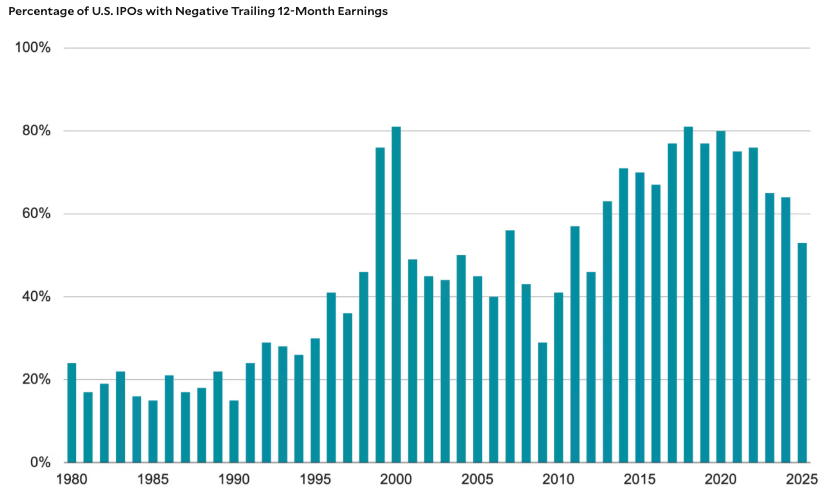
Data from 1/1/1980 – 12/31/2025. Source: Jay Ritter, “Initial Public Offerings: Updated Statistics, “Warrington College of Business, University of Florida, April 14, 2026.
SpaceX, OpenAI, & Anthropic IPOs: What Investors Should Know
Although these companies operate in different industries, they share several characteristics that attract investor attention. Each is a leader in a rapidly growing field. Each has achieved a substantial private-market valuation. If they eventually go public, they could rank among the largest IPOs in history. While their long-term business prospects may be compelling, investors should remember that a great company is not always a great investment at every price.
If investors have an opportunity to invest in IPOs before trading begins, should they jump? Second, do big-name IPOs offer a better investment opportunity than the majority of IPOs, which are typically small cap companies? And does the increasingly active IPO market tell us anything about the direction of the broader stock market?
One potential performance headwind for IPOs is the expiration of lockup agreements. Generally, a large percentage of the IPO shares held by insiders are subject to lockup provisions that prevent such insiders from selling shares on the open market shortly after the IPO. When the lockup agreements expire, usually six to 12 months after the initial offering, these shares may be sold in the marketplace, creating a liquidation event that puts downward pressure on the stock price.
Did Investors Already Miss Out on the Upside of SpaceX, OpenAI, and Anthropic IPOs?
What makes potential SpaceX, OpenAI, and Anthropic IPOs unusual is their size. If these companies eventually go public at the valuations currently being discussed, they could rank among the largest public offerings in history.
The current record valuation, or market capitalization, at IPO is $1.7 trillion for Saudi Aramco in 2019. Alibaba holds the mantle for the largest IPO on a U.S. stock exchange, with a market capitalization of about $169 billion. SpaceX could become the largest IPO ever by total valuation and immediately jump into the top 10 of the world’s largest publicly traded companies.
For reference, Amazon went public in 1997 with a valuation of approximately $438 million, while Microsoft went public in 1986 at a valuation of about $777 million. Both companies entered the public markets early in their growth cycles and used public capital to help fuel their expansion. As they grew into companies worth nearly $3 trillion today, public investors participated in much of that value creation.
By contrast, many of today’s most anticipated IPO candidates have already achieved massive private-market valuations before reaching public investors. With abundant access to private capital, companies are often able to stay private much longer than in previous decades. As a result, some investors question whether a larger share of a company’s growth occurs before its IPO, potentially reducing future returns for investors who buy shares after the company goes public.
Lessons From Meta and Uber IPOs
Investors should also consider past high-profile IPOs from Facebook (now Meta) and Uber.
Both companies managed widely used consumer products, and their IPOs were the first opportunities for everyday investors to own shares in these businesses. Four months after the Facebook/Meta IPO in May 2012, the stock declined by more than 50% and took over a year to return to its IPO price. Similarly, Uber saw its price slide by about a third in the first five months and also took more than a year to trade consistently above its IPO price.
While these are just two examples of the thousands of IPOs over time, their results aren’t outside the norm. In fact, a broad body of research has shown that, on average, IPOs have historically underperformed for some time after listing relative to similar companies that have traded publicly for years.
U.S. IPOs on Average Underperform Companies of Similar Size and Valuation in the First Five Years After Listing
Returns over Periods Post-IPO (1980-2024)
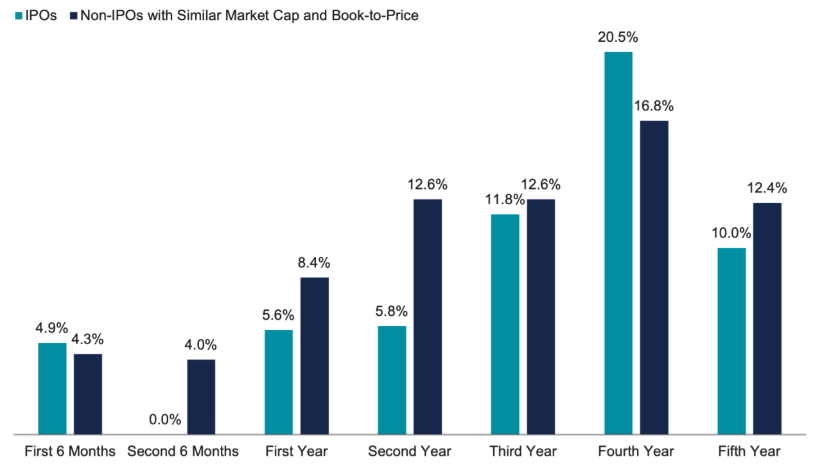
Data from 1/1/1980 – 12/31/2024. Source: Jay Ritter, “Initial Public Offerings: Updated Long-Run Statistics,” Warrington College of Business, University of Florida, March 23, 2026. Past performance is no guarantee of future results.
Should Investors Include IPOs in Their Portfolios
It’s easy to see why there’s buzz about these companies going public, but whether they should be viewed as good investments when they hit the market is a separate issue. When large, well-known companies announce their plans to go public, expect to see significant media coverage. These events are newsworthy, especially when they involve companies that are larger than most existing public firms and may introduce new opportunities related to popular investment themes.
As investors, excitement surrounding SpaceX, OpenAI, and Anthropic IPOs should not prevent us from evaluating these opportunities through a disciplined investment framework. Successful businesses can still produce disappointing investment returns if purchased at excessive valuations.
Whether considering a newly public company or a long-established market leader, investors should focus on fundamentals, cash flows, profitability, and valuation. History suggests that patience and disciplined portfolio construction often matter more than gaining access to the latest IPO.
As always, we are here to help.
* * * * * * * * * * * * * * * * * *
Historical performance results for investment indices, benchmarks, and/or categories have been provided for general informational/comparison purposes only, and generally do not reflect the deduction of transaction and/or custodial charges, the deduction of an investment management fee, nor the impact of taxes, the incurrence of which would have the effect of decreasing historical performance results. It should not be assumed that your account holdings correspond directly to any comparative indices or categories. Need to add more disclosures.
About CAM Investor Solutions
CAM Investor Solutions, a fee-only independent Registered Investment Advisor, has offices located in Colorado, Florida, and Texas. As a growing wealth management firm, we focus on the needs of our clients to improve their quality of life. Our firm’s commitment to innovation through rigorous academic research enhances how we serve a multi-generational audience.
CAM’s Specialties Include:
- Managing concentrated wealth
- Planning for stock and option compensation / company IPOs
- Advanced tax managed investment strategies
- Custom retirement income strategies
- Cash management
Contact:
CAM Investor Solutions
info@caminvestor.com
1-844-247-0787
https://caminvestor.com
CAM Disclosure
SOURCE: Avantis Investors, Dimensional Fund Advisors, Bloomberg, Reuters, Jay Ritter, “Initial Public Offerings: Updated Long-Run Statistics,” Warrington College of Business, University of Florida. Nvidia, Amazon, Meta market capitalization figures as of 4/30/2026. Saudi Aramco and Alibaba market capitalizations are at the time of their respective IPOs. SpaceX market capitalization is an anticipated level for its expected IPO in late 2026.
M & A Consulting Group, LLC, doing business as CAM Investor Solutions is an SEC registered investment adviser. As a fee-only firm, we do not receive commissions nor sell any insurance products. We provide financial planning and investment information that we believe to be useful and accurate. However, there cannot be any guarantees.
This blog has been provided solely for informational purposes and does not represent investment advice. Nor does it provide an opinion regarding fairness of any transaction. It does not constitute an offer, solicitation or a recommendation to buy or sell any particular security or instrument or to adopt any investment strategy.
Past performance is not a guarantee of future results. Diversification does not eliminate the risk of market loss. Tax planning and investment illustrations are provided for educational purposes and should not be considered tax advice or recommendations. Investors should seek additional advice from their financial advisor or tax professional.


Related Posts