The Federal Reserve raised rates again, and rising interest rates look…
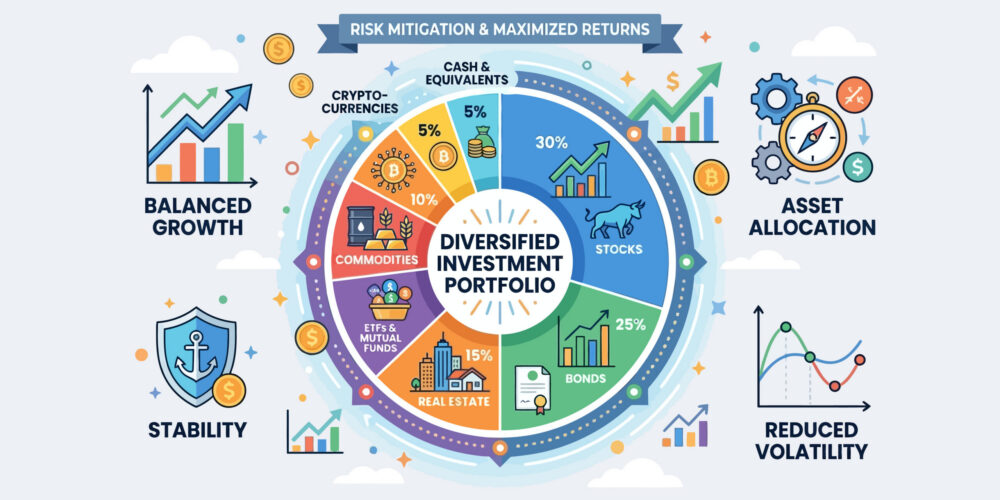
Diversification Isn’t Dead, Just Forgotten
A recurring question deserves a recurring answer: no, diversification isn’t dead. Here’s what the data, and market history, actually show.
We’ve lost count of how many times we’ve heard “diversification is dead” from active managers over the past three decades. The claim resurfaces on a predictable schedule. Whenever U.S. large-cap stocks lead the market for an extended stretch, as they did in 2023 to 2024, conventional wisdom shifts toward a simple pitch: just buy the S&P 500 and be done with it.
But investors who hold only the S&P 500 still sit in a concentrated portfolio, even with exposure to hundreds of individual companies. Stocks within a single asset class tend to be highly correlated. They rise and fall together. Owning 500 large-cap U.S. stocks isn’t the same as owning a diversified portfolio. It’s one bet, sized 500 ways.
Why a Diversified Portfolio Isn’t Dead, It’s Necessary
A well-diversified portfolio extends beyond U.S. large-cap stocks. It includes asset classes with different return drivers, such as U.S. and international small-cap stocks and emerging markets. Recent asset class performance shows clear windows where diversification delivered relative benefits beyond what large-cap alone provided.
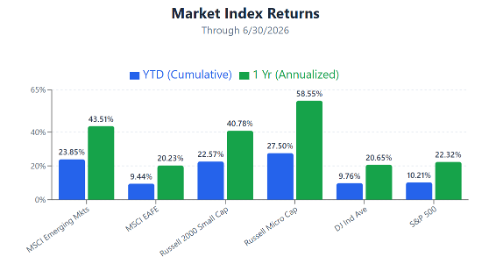
Source: Morningstar, Inc. Past performance is no guarantee of future results. Indices are not available for direct investment. Their performance does not reflect the expenses associated with the management of an actual portfolio.
The “diversification doesn’t work” narrative tends to peak at exactly the wrong moment: right after a run of large-cap outperformance, just before market leadership typically rotates. That’s when discipline across asset classes and investment styles matters most. Read about What Happens After All-Time Market Highs.
The Real Culprit Behind the Diversification Myth: Recency Bias
So why do investors keep making the same mistake? A well-documented cognitive bias explains it. We call it recency bias: the tendency to take current conditions and project them indefinitely into the future.
Recency bias makes investors feel invincible in bull markets and hopeless in bear markets. The emotional logic is simple, and simply wrong: whatever the market is doing right now must be what it keeps doing. Staying anchored to your long-term strategy, the one your Investment Policy Statement lays out, is one of the most effective defenses against this bias.
A More Dangerous Form of Recency Bias
There’s a subtler, more corrosive version worth naming: the belief that today’s problems are permanent and unsolvable. Big problems feel that way because they’re known. Nobody’s invented the solutions yet. This version is more dangerous. It breeds a cynicism that borders on fatalism. That fatalism can push investors to abandon their strategy entirely, because the future looks hopelessly bleak.
Why Diversification Still Works: Innovation Rarely Announces Itself
History suggests otherwise. Consider three breakthroughs that made headlines in just the second quarter of 2026 alone:
- Cooling technology for AI infrastructure: Researchers at the University of Illinois Urbana-Champaign developed 3D-printed copper cooling plates that could cut a data center’s cooling energy usage from roughly 30% of total power draw down to about 1.1%.
- Nuclear fusion funding: Google committed $468 million to Proxima Fusion, a German company building toward the world’s first commercial nuclear fusion reactor. Unlike fission plants, fusion reactors don’t carry meltdown risk.
- Domestic energy access: U.S. petroleum engineers announced drilling technology that could unlock tens of billions of barrels of previously inaccessible oil in U.S. coastal waters.
These solutions rarely dominate headlines the way the underlying problems do. They emerge quietly. Thousands of people work on hard technical problems out of public view, and the results seem to appear out of nowhere. Human ingenuity remains the most underestimated force in any long-term forecast, market or otherwise.
The Bottom Line: Diversification Isn’t Dead
Diversification isn’t dead. It simply falls out of favor during extended large-cap rallies, the exact moments when investors need it most as leadership eventually rotates. Recognizing recency bias, in both its market and societal forms, is one of the most valuable disciplines an investor can practice. Read more on managing market volatility: Market Timing Mistakes: Why “This Time It’s Different” Fails
Frequently Asked Questions
Is diversification dead, or just forgotten? Neither, in the sense of being gone for good. Investors forget the value of diversification during extended runs of U.S. large-cap outperformance, like 2023 to 2024. Diversified exposure to other asset classes, including small-cap and emerging market stocks, has historically provided relative benefits during different market cycles. A single asset class, even a broad index like the S&P 500, still carries correlated risk.
Why does the S&P 500 count as a “concentrated” investment? Stocks within the same asset class tend to be highly correlated. They rise and fall together. The S&P 500 offers exposure to hundreds of companies, but they’re all U.S. large-cap stocks. That’s one asset class, not a diversified portfolio.
What is recency bias in investing? Recency bias is the tendency to assume current market or economic conditions will continue indefinitely. It drives overconfidence in bull markets and excessive pessimism in bear markets. It can lead investors to abandon long-term strategies at exactly the wrong time.
How can investors guard against recency bias? Anchor your decisions to a written long-term strategy, such as an Investment Policy Statement. It helps you avoid reactive decisions based on short-term market conditions.
As always, CAM Investor Solutions is here to help.
* * * * * * * * * * * * * * * * * *
Historical performance results for investment indices, benchmarks, and/or categories have been provided for general informational/comparison purposes only, and generally do not reflect the deduction of transaction and/or custodial charges, the deduction of an investment management fee, nor the impact of taxes, the incurrence of which would have the effect of decreasing historical performance results. It should not be assumed that your account holdings correspond directly to any comparative indices or categories. Need to add more disclosures.
About CAM Investor Solutions
CAM Investor Solutions, a fee-only independent Registered Investment Advisor, has offices located in Colorado, Florida, and Texas. As a growing wealth management firm, we focus on the needs of our clients to improve their quality of life. Our firm’s commitment to innovation through rigorous academic research enhances how we serve a multi-generational audience.
CAM’s Specialties Include:
- Managing concentrated wealth
- Planning for stock and option compensation / company IPOs
- Advanced tax managed investment strategies
- Custom retirement income strategies
- Cash management
Contact:
CAM Investor Solutions
info@caminvestor.com
1-844-247-0787
https://caminvestor.com
CAM Disclosure
SOURCE: Morningstar, Bloomberg.
M & A Consulting Group, LLC, doing business as CAM Investor Solutions is an SEC registered investment adviser. As a fee-only firm, we do not receive commissions nor sell any insurance products. We provide financial planning and investment information that we believe to be useful and accurate. However, there cannot be any guarantees.
This blog has been provided solely for informational purposes and does not represent investment advice. Nor does it provide an opinion regarding fairness of any transaction. It does not constitute an offer, solicitation or a recommendation to buy or sell any particular security or instrument or to adopt any investment strategy.
Past performance is not a guarantee of future results. Diversification does not eliminate the risk of market loss. Tax planning and investment illustrations are provided for educational purposes and should not be considered tax advice or recommendations. Investors should seek additional advice from their financial advisor or tax professional.


Related Posts