The Magnificent 7 dominate today's market headlines and index weightings. Forty-five…

3 Proven Lessons About Market Declines From a Century of Data
Market declines are unsettling while you are living through one. Nearly a hundred years of US stock data offer some perspective on what has tended to happen next.
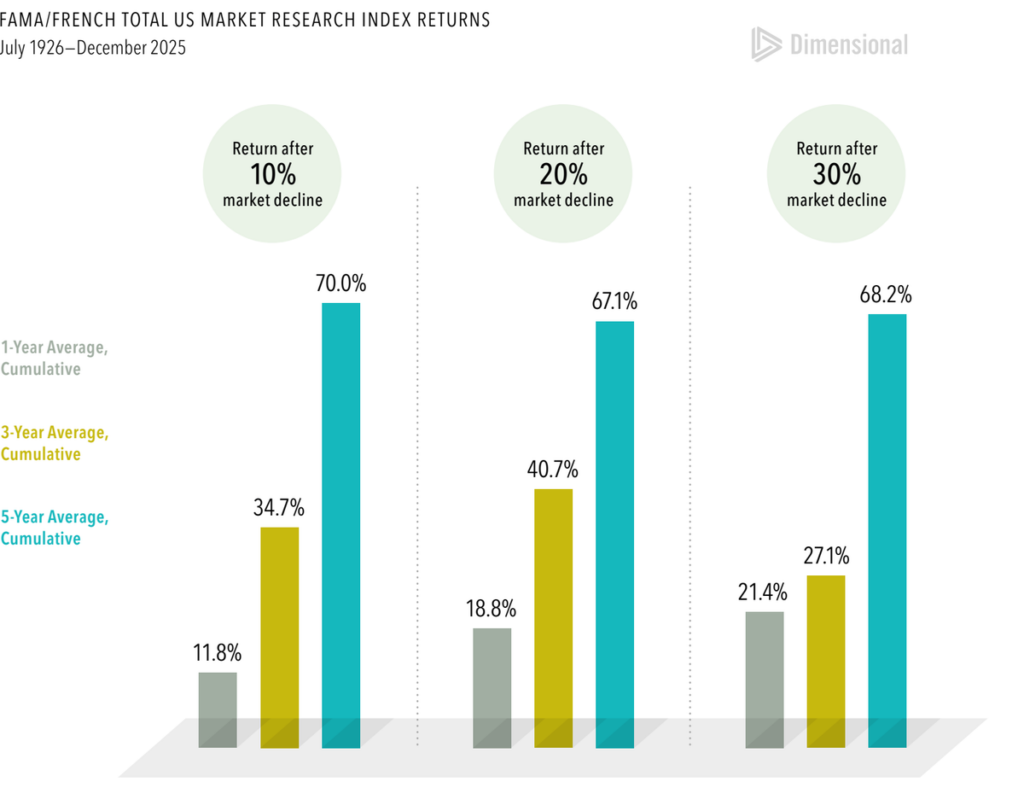
SOURCE: Dimensional. Fama/French Total US Market Research Index Returns, July 1926 to December 2025
Lesson 1: Returns after market declines have been positive
Dimensional measured US stock returns over the one, three, and five years following every 10%, 20%, and 30% decline since July 1926. The averages came out positive in all nine combinations.
| Decline from peak | 1 year | 3 years | 5 years |
|---|---|---|---|
| 10% | 11.8% | 34.7% | 70.0% |
| 20% | 18.8% | 40.7% | 67.1% |
| 30% | 21.4% | 27.1% | 68.2% |
Average cumulative returns following each decline threshold. Fama/French Total US Market Research Index, July 1926 to December 2025.
These are averages, not guarantees. Individual periods varied widely, and some produced losses.
Lesson 2: Five years out, the numbers get striking
The one-year figures are modest. The five-year figures are not.
Every threshold topped 50%. The depth of the decline barely changed the five-year outcome.
That last point deserves a pause. A 30% drop feels three times worse than a 10% drop while it is happening. Five years later, the average recovery looked about the same.
Lesson 3: Bear markets have not been the worst time to invest
A 20% decline marks the threshold for a bear market. That is the point where headlines turn grim and selling feels sensible.
Stocks rebounded notably from there, as the table above shows.
One honest caveat. The three-year figure after a 30% decline is 27.1%, lower than after a 10% or 20% decline. Declines that steep happened only seven times since 1926, so one unusual period moves that average a lot.
What this means for your plan
Averages describe the past. They do not predict the next decline or the recovery that follows.
What the data does say is narrower and more useful. Selling after a decline locks in the loss and puts you outside the market during the period when returns have historically been strongest.
Sticking with your plan keeps you positioned to capture the recovery. If your allocation still matches your time horizon and your need for cash, a market decline is a reason to check that it does, not a reason to change it.
Frequently asked questions about market declines
What counts as a market decline?
This analysis uses three thresholds: a cumulative fall of 10%, 20%, or 30% from a prior all-time high. A 20% decline is the common definition of a bear market.
What have stocks returned after a market decline?
On average, positive returns across one, three, and five years. Five years after a 10% decline, the average cumulative return was 70.0%. After a 20% decline, 67.1%. After a 30% decline, 68.2%.
Do deeper declines produce bigger rebounds?
Not consistently. Five-year returns were similar across all three thresholds. At three years, the average after a 30% decline was actually lower than after a 20% decline. Declines of 30% or more occurred only seven times since 1926, so that figure rests on a small sample.
Should I sell when the market drops?
Selling converts a paper loss into a realized one and leaves you out of the market during the stretch when returns have historically been strongest. Whether your allocation still fits is a separate question, and one worth discussing with your advisor.
How far back does this data go?
July 1926 through December 2025, using the Fama/French Total US Market Research Index.
As always, CAM Investor Solutions is here to help.
* * * * * * * * * * * * * * * * * *
Historical performance results for investment indices, benchmarks, and/or categories have been provided for general informational/comparison purposes only, and generally do not reflect the deduction of transaction and/or custodial charges, the deduction of an investment management fee, nor the impact of taxes, the incurrence of which would have the effect of decreasing historical performance results. It should not be assumed that your account holdings correspond directly to any comparative indices or categories. Need to add more disclosures.
About CAM Investor Solutions
CAM Investor Solutions, a fee-only independent Registered Investment Advisor, has offices located in Colorado, Florida, and Texas. As a growing wealth management firm, we focus on the needs of our clients to improve their quality of life. Our firm’s commitment to innovation through rigorous academic research enhances how we serve a multi-generational audience.
CAM’s Specialties Include:
- Managing concentrated wealth
- Planning for stock and option compensation / company IPOs
- Advanced tax managed investment strategies
- Custom retirement income strategies
- Cash management
Contact:
CAM Investor Solutions
info@caminvestor.com
1-844-247-0787
https://caminvestor.com
CAM Disclosure
SOURCE: Dimensional
Adapted from a Dimensional Quick Take. Chart and underlying data: Fama/French Total US Market Research Index, July 1926 to December 2025, in USD.
M & A Consulting Group, LLC, doing business as CAM Investor Solutions is an SEC registered investment adviser. As a fee-only firm, we do not receive commissions nor sell any insurance products. We provide financial planning and investment information that we believe to be useful and accurate. However, there cannot be any guarantees.
This blog has been provided solely for informational purposes and does not represent investment advice. Nor does it provide an opinion regarding fairness of any transaction. It does not constitute an offer, solicitation or a recommendation to buy or sell any particular security or instrument or to adopt any investment strategy.
Past performance is not a guarantee of future results. Diversification does not eliminate the risk of market loss. Tax planning and investment illustrations are provided for educational purposes and should not be considered tax advice or recommendations. Investors should seek additional advice from their financial advisor or tax professional.


Related Posts