With the November midterms just months away, campaign coverage is intensifying…

Market Timing Doesn’t Work, It Never Has
Every time stocks run up, the “market has no room left to run” chorus starts again. It’s just market timing dressed up as analysis, and history says it doesn’t hold up.
It’s tempting to look at a recent market runup and conclude there’s no room left in this bull market. That conclusion gets easier to reach the longer you listen to financial news pundits practice market timing on air, debating whether stocks are overvalued or undervalued. It’s no surprise that many of them lean toward “overvalued” after a strong runup, then advise investors to pull back from equities before a downturn hits.
But are they right? Do they have some crystal ball the rest of us lack? The historical record says no, repeatedly.
Why Market Timing Doesn’t Work, Even for the Experts
Market timers, no matter how credentialed, haven’t shown a reliable ability to predict where the market is headed in the near term. Forecasters have a long track record of getting it wrong, and confident predictions rarely hold up once you check them against what actually happened.
Look back at market history and you’ll find countless bull markets that ran for months, even years, beyond what conventional wisdom thought possible.
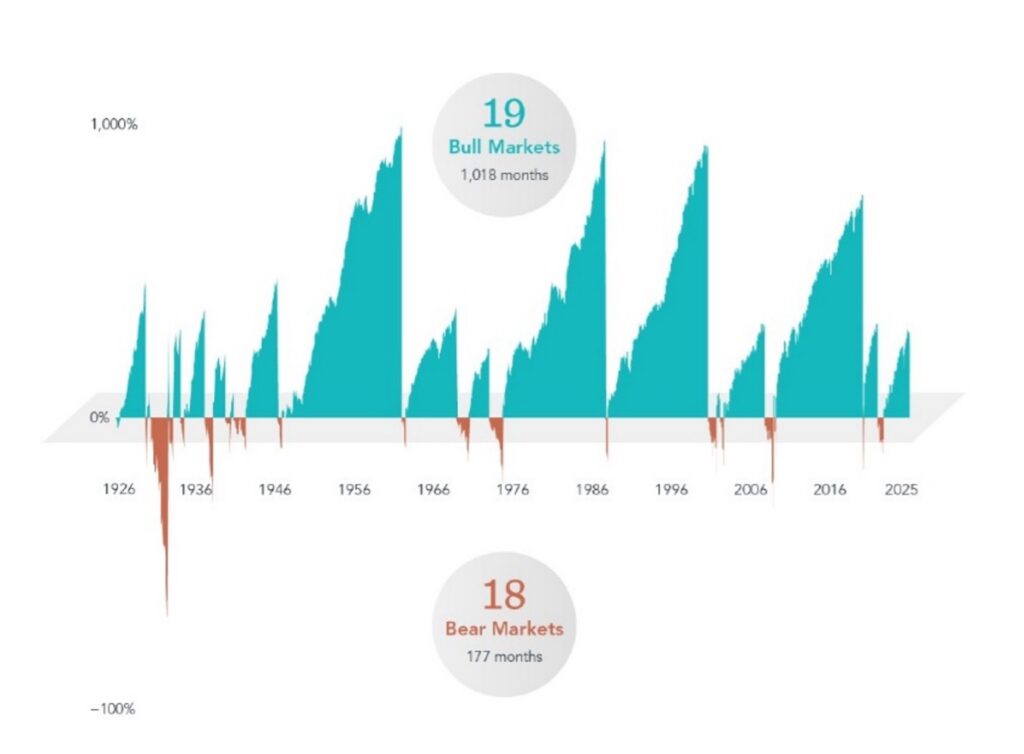
Source: Dimensional, Inc. Past performance is no guarantee of future results. Indices are not available for direct investment. Their performance does not reflect the expenses associated with the management of an actual portfolio.
More Proof Market Timing Doesn’t Work: Bull Market History
Markets that look “tapped out” often keep climbing. We’ve seen this pattern before: investors assume a market high signals the top, pull back, and miss the continued gains that follow. Predicting a ceiling in real time is far harder than it looks in hindsight.
Skip Market Timing: Markets Are Fairly Valued, Most of the Time
We believe the market is generally fairly valued, meaning stock prices reflect all publicly known information at any given time. Whether stocks are over- or undervalued today will only become clear in hindsight, once future events unfold. Those events are inherently unknowable and unpredictable. Information that isn’t already public can’t legally be traded on, which is exactly why it can’t be priced in ahead of time, and why market timing keeps coming up short.
For long-term investors, the more useful move is to stay focused on the market’s long-term upward trend and skip the market timing altogether. Let short-term, short-lived declines come and go as they will. The SEC’s own investor education resources make the same point: investors who stay invested through the ups and downs tend to fare better than those who try to jump in and out.
Historical performance results for investment indices, benchmarks, and categories are provided for general informational and comparison purposes only. They generally do not reflect transaction or custodial charges, investment management fees, or taxes, all of which would reduce historical performance results. Your account holdings may not correspond directly to any comparative indices or categories.
Diversification does not ensure a profit or protect against loss, and different asset classes may experience extended periods of underperformance.
Frequently Asked Questions
Does market timing actually work? No. Even credentialed professional market timers haven’t shown a reliable ability to predict short-term market direction. The historical record shows repeated failed predictions about market tops and bottoms.
Is the market overvalued right now? Stock prices generally reflect all publicly known information at any given time, which is why they’re best described as fairly valued rather than over- or undervalued. Whether today’s prices turn out to be too high or too low will only be clear in hindsight.
How long can a bull market run? Longer than most people expect. Market history includes many bull markets that continued for months or years past the point where conventional wisdom assumed they’d end.
What should long-term investors do instead of timing the market? Stay focused on the market’s long-term upward trend, and let short-term declines run their course rather than reacting to them.
As always, CAM Investor Solutions is here to help.
* * * * * * * * * * * * * * * * * *
Historical performance results for investment indices, benchmarks, and/or categories have been provided for general informational/comparison purposes only, and generally do not reflect the deduction of transaction and/or custodial charges, the deduction of an investment management fee, nor the impact of taxes, the incurrence of which would have the effect of decreasing historical performance results. It should not be assumed that your account holdings correspond directly to any comparative indices or categories. Need to add more disclosures.
Diversification does not ensure a profit or protect against loss, and different asset classes may experience extended periods of underperformance.
About CAM Investor Solutions
CAM Investor Solutions, a fee-only independent Registered Investment Advisor, has offices located in Colorado, Florida, and Texas. As a growing wealth management firm, we focus on the needs of our clients to improve their quality of life. Our firm’s commitment to innovation through rigorous academic research enhances how we serve a multi-generational audience.
CAM’s Specialties Include:
- Managing concentrated wealth
- Planning for stock and option compensation / company IPOs
- Advanced tax managed investment strategies
- Custom retirement income strategies
- Cash management
Contact:
CAM Investor Solutions
info@caminvestor.com
1-844-247-0787
https://caminvestor.com
CAM Disclosure
SOURCE: Dimensional Fund Advisors, Bloomberg.
M & A Consulting Group, LLC, doing business as CAM Investor Solutions is an SEC registered investment adviser. As a fee-only firm, we do not receive commissions nor sell any insurance products. We provide financial planning and investment information that we believe to be useful and accurate. However, there cannot be any guarantees.
This blog has been provided solely for informational purposes and does not represent investment advice. Nor does it provide an opinion regarding fairness of any transaction. It does not constitute an offer, solicitation or a recommendation to buy or sell any particular security or instrument or to adopt any investment strategy.
Past performance is not a guarantee of future results. Diversification does not eliminate the risk of market loss. Tax planning and investment illustrations are provided for educational purposes and should not be considered tax advice or recommendations. Investors should seek additional advice from their financial advisor or tax professional.


Related Posts